
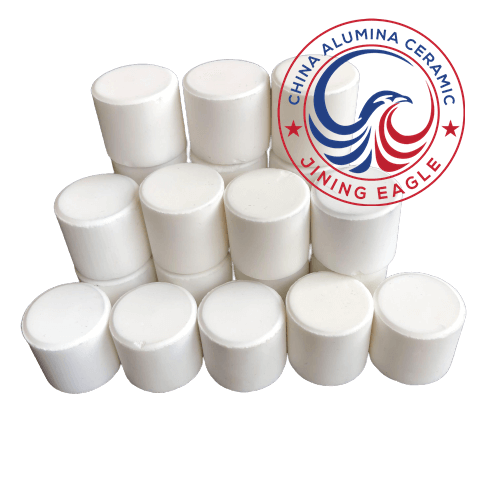

WHAT IS High Alumina Grinding Column
Alumina grinding column refers to the high-temperature calcined Alpha alumina powder as raw material, through batching, grinding, powder making, molding, drying, firing, and other processes
Alumina ceramic grinding columns make great ceramics, glasses, and enamels in chemical factories and other industries with ball mills, can-type mills, and vibration mills as their main machinery. Al2O3 Alumina grinding cylinder can also be used in these industries: metallic minerals, non-metallic minerals , silicon carbide, talcum, white pigments, cosmetics, cement, building materials.
High Alumina Ceramic Grinding Column applications
Apart from grinding usages, you can form rubber-backed ceramic wear liners with our alumina grinding cylinders. The main application for Alumina Ceramic Column is within the mining industry.
We suggest Al2O3 alumina grinding cylinders for stirred mills and ball mills preferably. Alumina grinding columns are widely used in different types of ceramics, enamels, glass, chemicals, etc. due to their excellent characteristics such as high strength, high hardness, high wear resistance, large specific volume, small volume, high-temperature resistance, and corrosion resistance.
high Alumina Grinding Column advantage
The alumina grinding column has a grinding efficiency and abrasion resistance far exceeding ordinary ball stone and natural pebbles. It is an excellent grinding medium for fine grinding equipment such as ball mills, pot mills, and vibration mills.
No abrasion, no corrosion, and no erosion. Alumina ceramic grinding columns resist almost everything. Acid, alkali, chips, extreme heat, and abrupt temperature changes, etc. Al2O3 Alumina grinding cylinder are also pollution-free, easy to clean, and 3-5 more durable than natural stone liners, and 23 times more durable than rubber liners. Installation and milling time are reduced at a minimum, while efficiency is augmented at a maximum.
- Wear-resistant low loss
- high-temperature resistance
- corrosion resistance
- High Mechanical Strength
high Al2O3 Alumina Ceramic Grinding cylinder specification
| Specification (mm) | Diameter (mm) | Height (mm) |
| Φ7*7 | 7 | 7 |
| Φ16*16 | 16 | 16 |
| Φ20*20 | 20 | 20 |
| Φ23*23 | 23 | 23 |
| Φ25*25 | 25 | 25 |
| Φ30*30 | 30 | 30 |
| Φ60*60 | 60 | 60 |
Alumina ceramic grinding Column Chemical Composition and Physical Properties
| Al2O3 | ≥ 92% | ≥ 95% |
| Fe2O3 | ≤ 0.01% | ≤ 0.01% |
| SiO2 | ≤ 5.28% | ≤ 2.6% |
| Na2O | ≤ 0.72% | ≤ 0.44% |
| Hardness | 9 Mohs | 9 Mohs |
| Water Absorption | ≤ 0.01% | ≤ 0.01% |
| Bulk Density | ≥ 3.6g/cm3 | ≥ 3.7g/cm3 |
| Compression Strength | ≥ 2000 Mpa | ≥ 2500 Mpa |
| Wear Loss | ≤ 0.001% | ≤ 0.0008% |
Note: As the grinding media, at a comparable weight with grinding balls, Al2O3 alumina ceramic grinding column have an approx.14% greater surface than alumina ceramic grinding ball.

Applications of Alumina Ceramic Grinding Columns
1. Grinding and Milling
- Industries: Used extensively in mining, ceramics, and chemical industries.
- Function: Ideal for grinding and milling operations due to their hardness and resistance to wear and tear.
- Materials: Suitable for processing minerals, ceramic powders, and various hard materials.
2. Ball Mills
- Use Case: Utilized as grinding media in ball mills.
- Advantages: Enhance grinding efficiency, reduce contamination, and improve product purity.
3. Chemical Processing
- Applications: Employed in the production of paints, pigments, and other chemical products.
- Benefits: Provide consistent performance and durability under corrosive conditions.
4. Food and Beverage Industry
- Role: Used for grinding raw materials in the production of food and beverages.
- Advantages: Ensure contamination-free processing, maintaining the quality and safety of food products.
5. Pharmaceuticals
- Usage: Integral in the manufacturing process of pharmaceutical products.
- Benefits: Maintain the integrity of active ingredients by providing a clean grinding process.
6. Advanced Ceramics
- Application: Assist in the production of advanced ceramic materials.
- Benefits: Enable precise and uniform grinding, essential for high-quality ceramic products.
7. Environmental Applications
- Use Case: Employed in recycling processes, especially for electronic waste.
- Advantages: Durable and effective in breaking down tough materials, facilitating efficient recycling.
Key Benefits
- High Hardness and Wear Resistance: Provides long service life and reduces the frequency of replacement.
- Chemical Inertness: Does not react with most materials, ensuring the purity of the product.
- Thermal Stability: Maintains performance under high-temperature conditions.
- Cost-Effective: Despite the higher initial cost, the durability and efficiency lead to overall cost savings.
Are there any limitations to using alumina ceramic grinding columns?
While they offer many advantages, alumina ceramic grinding cylinders may have limitations such as higher initial cost compared to other materials and potential brittleness under extreme impact conditions. Proper handling and usage are essential to maximize their lifespan and performance. Despite the higher upfront cost, their long-term cost efficiency and performance benefits often outweigh this disadvantage.
What is the typical lifespan of alumina ceramic grinding cylinders?
The lifespan of alumina ceramic grinding columns varies depending on the specific application, operating conditions, and maintenance practices. However, due to their high hardness and wear resistance, they generally have a lifespan that is 2-3 times longer than that of steel grinding media. For example, in a standard ball mill operation, alumina ceramic grinding cylinders can last up to 5000 hours compared to 2000 hours for steel balls.
How do alumina ceramic grinding columns compare to other grinding media?
Compared to other grinding media like steel or zirconia, alumina ceramic grinding cylinders offer superior hardness and wear resistance, chemical inertness, and reduced contamination. They are also cost-effective in the long run due to their durability and low maintenance requirements. For instance, alumina media have a density of 3.6 g/cm³, compared to steel’s 7.8 g/cm³, leading to lower energy consumption in milling.
What sizes are available for alumina ceramic grinding cylinders?
Alumina ceramic grinding columns come in various sizes to suit different milling and grinding applications. The specific size required depends on the type of mill and the material being processed. Manufacturers typically offer a range of diameters from 0.5 mm to 60 mm and lengths up to 100 mm.
Can alumina ceramic grinding columns be used in food and pharmaceutical industries?
Yes, they are suitable for use in the food and pharmaceutical industries due to their chemical inertness and ability to provide a contamination-free grinding process. This helps maintain the quality and safety of food and pharmaceutical products. For example, in pharmaceutical milling, the use of alumina ceramic grinding cylinders can result in a product purity of over 99.9%.
How do alumina ceramic grinding cylinders improve milling efficiency?
They improve milling efficiency by providing a harder and more durable grinding surface, which reduces the frequency of media replacement and ensures a more consistent grinding action. This leads to finer and more uniform particle sizes and reduces contamination of the processed material. Studies have shown that alumina ceramic grinding columns can enhance milling efficiency by 20-30%.
What are the benefits of using alumina ceramic grinding columns?
The benefits include high hardness (with a Mohs hardness of around 9), wear resistance, chemical inertness, thermal stability, and cost-effectiveness. These properties lead to a longer service life, reduced contamination, consistent performance, and overall cost savings. They typically have a wear rate of 0.1-0.2% per hour, significantly lower than other materials.


