
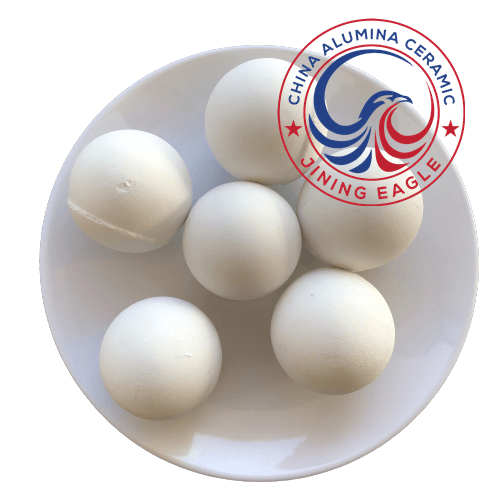
What is high alumina grinding media used for?
- Ceramics Industry: Used for grinding ceramic raw materials, glazes, and frits in the production of ceramic tiles, sanitaryware, and advanced ceramics.
- Cement Industry: Employed in grinding raw materials like limestone, clay, shale, and iron ore to produce cement clinker.
- Mining Industry: Used in grinding ores and minerals to finer particles for mineral processing, such as gold, copper, zinc, and iron ores.
- Paints and Coatings Industry: Utilized for dispersing pigments, fillers, and additives in paints, coatings, and inks to achieve desired color and texture properties.
- Chemical Industry: Used in grinding chemicals and raw materials in processes like production of pigments, dyes, and specialty chemicals.
- Pharmaceutical Industry: Employed in grinding pharmaceutical ingredients and chemicals for the production of medicines and pharmaceutical formulations.
High alumina grinding media are preferred in these applications due to their superior wear resistance, hardness (typically 9 Mohs), and chemical inertness, which ensure minimal contamination and consistent performance over extended periods.
Are high alumina grinding media cost-effective?
Despite higher initial costs compared to some other grinding media, high alumina grinding media offer significant cost savings over their lifespan due to their extended durability and reduced replacement frequency. Proper handling, storage, and regular maintenance are critical to optimizing their cost-effectiveness in industrial grinding operations.
What sizes and specifications are available for high alumina grinding media?
High alumina grinding media come in various sizes typically ranging from 1 mm to 50 mm in diameter for balls and various lengths for cylinders. They are available in different formulations and densities tailored to specific grinding applications across industries.
What advantages do high alumina grinding media offer compared to other types of grinding media?
High alumina grinding media offer superior wear resistance, durability, and chemical inertness. They maintain high grinding efficiency over prolonged use, resulting in reduced media consumption and minimal contamination of ground materials compared to steel balls or glass beads.
How are high alumina grinding media manufactured?
High alumina grinding media are manufactured from high-purity alumina ceramics, typically with alumina content ranging from 92% to 99.5%. They are shaped into balls or cylinders and fired at temperatures exceeding 1700°C to ensure high density, hardness (typically 9 Mohs), and exceptional wear resistance.
What are high alumina grinding media used for?
High alumina grinding media are essential in industries such as ceramics, mining, cement, paints and coatings, chemicals, and pharmaceuticals. They are used for grinding ceramic raw materials, ores, cement clinker, pigments, chemicals, and pharmaceutical ingredients to achieve desired particle size and quality.

WHAT IS Alumina ceramic Grinding Balls Wet Grinding
High alumina balls is also called alumina ceramic balls, alumina grinding ball, etc. It is an inert ball with no voids inside and has good wear resistance, corrosion resistance and high temperature resistance. These Alumina ceramic grinding balls made of top-notch materials with the latest molding technology. Later, they’re burnt in high-temperature tunnel kilns. The result is an alumina product with high-density and high hardness that’s also resistant to corrosion and wear. The main component of alumina grinding ball is alpha alumina, which is divided into high alumina ball and medium alumina ball according to the content of Al2O3.
Alumina ceramic Balls WET GRINDING Application
The alumina ceramic balls stabilizes the chemical composition of the material being grind. Alumina grinding balls are mainly used as grinding media. It has great seismic stability and it’s ideal for grinding glaze and blank. It’s also perfect for mineral powder processing, for which it’s widely used in the inorganic mineral powder industry. Additionally, it can be found in the cement, paint, and many refractory materials industries, as part of the equipment for metal and non-metal dry powder grinding. High alumina ceramic grinding balls is a neutral material, a solid insoluble in water, and is often used as a wear-resistant abrasive material.
- Advanced ceramics
- Bio technologies
- Chemicals including fungicides, insecticides
- Coatings, paints, printing and inks
- Electronic materials and components
- Food processing
- Lithium ion battery materials
- Minerals processing
- Pigments and dyes
- Pharmaceuticals
Alumina Grinding Balls For Wet Grinding advaNtages
Alumina grinding balls for ball mills (Al2O3) have lower abrasion, high hardness, and impact resistance amongst their main characteristics. But they’re also cost-effective, as they increase grinding efficiency by 40-60% (which lets you save energy and money); and eco-friendly, as they do not contaminate the environment. The durability of the Alumina Ceramic balls is remarkable as well: they are 20 to 40 times more resistant to wear in comparison with natural and common balls.
- Low abrasion
- High hardness and density
- Impact resistance
- Energy Efficient
- Environment friendly
- Corrosion resistance
Alumina Ceramic Balls Chemical Composition & Technical Parameter
According to different alumina content, high alumina balls can be divided into 90, 92, 95, 99 series
| Item | AK-92 | AK-95 | AK-95 |
| Al2O3 (%) | ≧92 | ≧95 | ≧95 |
| BulK DENSITY (g/cm3) | ≧3.65 | ≧3.68 | ≧3.68 |
| Hardness (mohs) | 9 | 9 | 9 |
| Wear Loss (%) | ≦0.01 | ≦0.008 | ≦0.01 |
| Water Absorption (%) | ≦0.01 | ≦0.01 | ≦0.01 |
| Color | White | White | White |
| Size (mm) | Rolling: 0.5mm≦D≦50mm | ||
| Pressing: 13mm≦D≦90mm | |||
| size can be customized according to customer’s requirement | |||
Questions and answers about Alumina ceramic balls application solutions
Welcome to inquire and purchase our 92% and 95% Alumina ceramic grinding balls. High-quality Al2O3 ceramic balls are the best companion for ball mills, which can save you 15%- 30% of the cost.


