
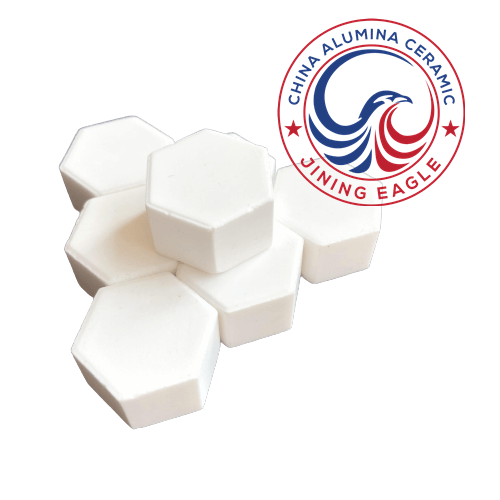

WHAT IS Alumina ceramic mosaic tile
ALUMINA CERAMIC MOSAIC TILE is a special corundum ceramic made of AL2O3 as the main raw material and fired at a high temperature of 1700 degrees Celsius. Our Alumina mosaic lining tile are resistant to wear, acid, salt, alkali, and organic solvents. Aalumina ceramic mosaic tile prevents corrosion and deterioration of the equipment, making it last longer. Alumina mosaic tiles are the best linings for high-impact and high-pressure applications, especially if the ceramic don’t have structural strength and high-performance rubber isn’t as durable as it’s required. In some cases, cube liners can support the ceramic or rubber matrix for extra wear life —while other products can’t.
Alumina mosaic tile Application
ALUMINA MOSAIC TILE are more suitable for the heavy industry. For many people, they’re a profitable, long-term solution as they withstand abrasion and corrosion. The key to these features is in their composition: alumina 92, alumina 95, alumina 96, and zirconia toughened alumina (ZTA). All together, they add up premium wear, thermal, and impact resistance to our products, usually found into liquid-flowing, GFRP ceramic pipes of machinery in the oil, mining, steel, and energy industries; or into transportation or delivery equipment like chutes, cement cyclones, cyclone separators, conveyor pulleys, metal elbows, preheaters with brackets, liners for pipelines or down spouting, etc.
Parallelly, square mosaic of Aalumina ceramic mosaic tile with 92% of aluminum oxide are used for all kinds of liners (chute, cyclone, hopper, screen equipment, piping, conveyor skirt, etc.) in coal plants, cement plants, steel & iron plants, railways, and ports. Also in the chemical and mineral processing industries.
- Coal Preparation Plants
- Mineral Processing Plants
- Cement Plants
- Chemical Plants
- Steel & Iron Plants
- Railway Stations
- Ports
Alumina mosaic lining tile advaNtages
Aalumina ceramic mosaic tile have a stable molecular structure that supports the impact of materials in pipe walls and helps the tiles to resist wear and erosion way more effectively than steel, stainless steel, manganese steel, and high chromium cast iron. Their Rockwell hardness is HRA 80-90 —almost as hard as a diamond. However, Alumina tiles are light pieces that make the equipment work at less load with no electrochemical corrosion, increasing its lifespan to its maximum extent, even in abrasive and extremely hot environments (their limit is around 1600ºC). Alumina ceramic have a smooth surface. They’re only 1/6 rough in comparison to steel pipes, which supplies them with less flow resistance.
- High hardness – The hardness of the Alumina mosaic tiles is second only to diamonds
- Excellent wear resistance – It’s wear resistance is 248 times higher than that of manganese steel, and 160 times higher than that of high-chromium cast iron.
- Light weight – It’s density is 3.6 g/cm3 , Only half of the steel, it can greatly reduce the energy consumption of the equipment
- Corrosion resistance
- Stability of heat temperature – The wear-resistant Alumina ceramic tiles is pasted on the inner wall of the equipment with heat-resistant superglue.
- Smooth surface
Alumina lining mosaic tile Chemical composition & Technical Parameter
| Item | AK-92 | AK-95 |
| Al2O3 (%) | ≧92 | ≧95 |
| BulK DENSITY (g/cm3) | ≧3.60 | ≧3.65 |
| Hardness (mohs) | 9 | 9 |
| Wear Loss (%) | ≦0.01 | ≦0.01 |
| Color | White | White |
Size
| Size | Length (mm) | Width (mm) | Thickness (mm) |
| Square Shape | 10-24 | 10-24 | 3-20 |
| Hexagon Shape | 12-20 | 12-20 | 3-15 |
Alumina mosaic tileAlumina mosaic tileAlumina mosaic lining tile
Questions and answers about Alumina mosaic tile application solutions
Welcome to inquire and purchase our from 92% to 95% Alumina mosaic tile. High-quality alumina grinding bricks are the best companion for ball mills, which can extend the life of the material conveying pipeline

Are alumina ceramic mosaic tiles cost-effective and environmentally sustainable?
Despite higher initial costs, alumina ceramic mosaic tiles offer significant cost savings over time due to reduced maintenance and downtime. They contribute to environmental sustainability by minimizing waste and energy consumption associated with frequent replacements, making them a sustainable choice for industrial wear solutions.
What sizes and specifications are available for alumina ceramic mosaic tiles?
Alumina ceramic mosaic tiles come in various sizes and thicknesses, ranging from small tiles to larger panels. They are designed with specific surface textures and configurations tailored to different industrial applications requiring abrasion resistance.
Which industries commonly use alumina ceramic mosaic tiles?
Alumina ceramic mosaic tiles are commonly used in mining, steel production, cement plants, and bulk material handling. They serve as protective linings in equipment prone to abrasion and impact, ensuring extended equipment life and reducing maintenance costs.
What advantages do alumina ceramic mosaic tiles offer over other materials?
Alumina ceramic mosaic tiles provide superior resistance to wear, chemicals, and temperatures compared to metals, plastics, and traditional ceramics. They are essential in industries like mining and steel for their longevity and reliability in harsh conditions.
What are alumina ceramic mosaic tiles used for and how are they made?
Alumina ceramic mosaic tiles are used for their high abrasion resistance and durability (typically 9 Mohs). They are made by compacting high-purity alumina powder into molds and firing them at temperatures exceeding 1500°C to achieve dense ceramic tiles.


